
How to Calculate Profit Margin: The Complete Guide for Small Business Owners

Why Profit Margin Matters More Than Revenue
Many business owners focus on increasing sales, but revenue alone doesn't determine whether a business is successful.
A company can generate hundreds of thousands of pounds in sales and still struggle financially if its profit margins are too low.
Understanding your profit margin is one of the most important steps towards building a profitable, sustainable business. Whether you're selling products, providing services, running an e-commerce store or managing a growing company, knowing exactly how much profit you make on every sale enables you to make smarter pricing decisions, manage costs effectively and plan for long-term growth.
In this guide, we'll explain what profit margin is, how to calculate it accurately, the common mistakes businesses make, and practical ways to improve profitability.
What Is Profit Margin?
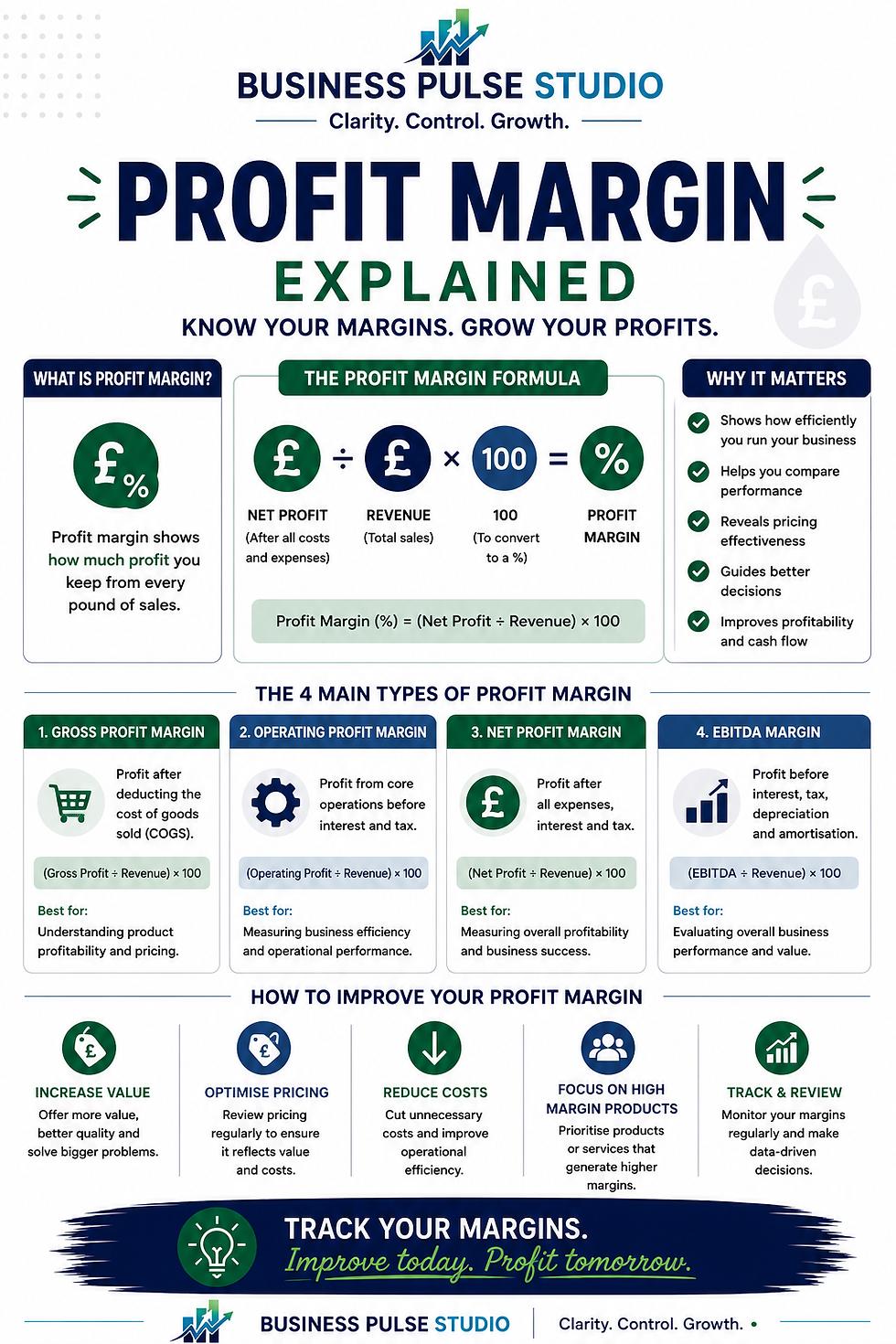
Profit margin is the percentage of each sale that remains as profit after deducting the costs associated with delivering your product or service.
Unlike revenue, which simply measures how much money comes into your business, profit margin measures how efficiently your business converts sales into profit.
For example:
Selling Price | Total Cost | Profit | Profit Margin |
£100 | £60 | £40 | 40% |
In this example, every £100 sale generates £40 in profit, resulting in a profit margin of 40%.
Why Is Profit Margin Important?
Monitoring profit margin allows you to understand whether your business is genuinely becoming more profitable or simply generating more sales.
Healthy profit margins provide greater financial stability and allow businesses to:
Invest in growth
Employ additional staff
Withstand rising costs
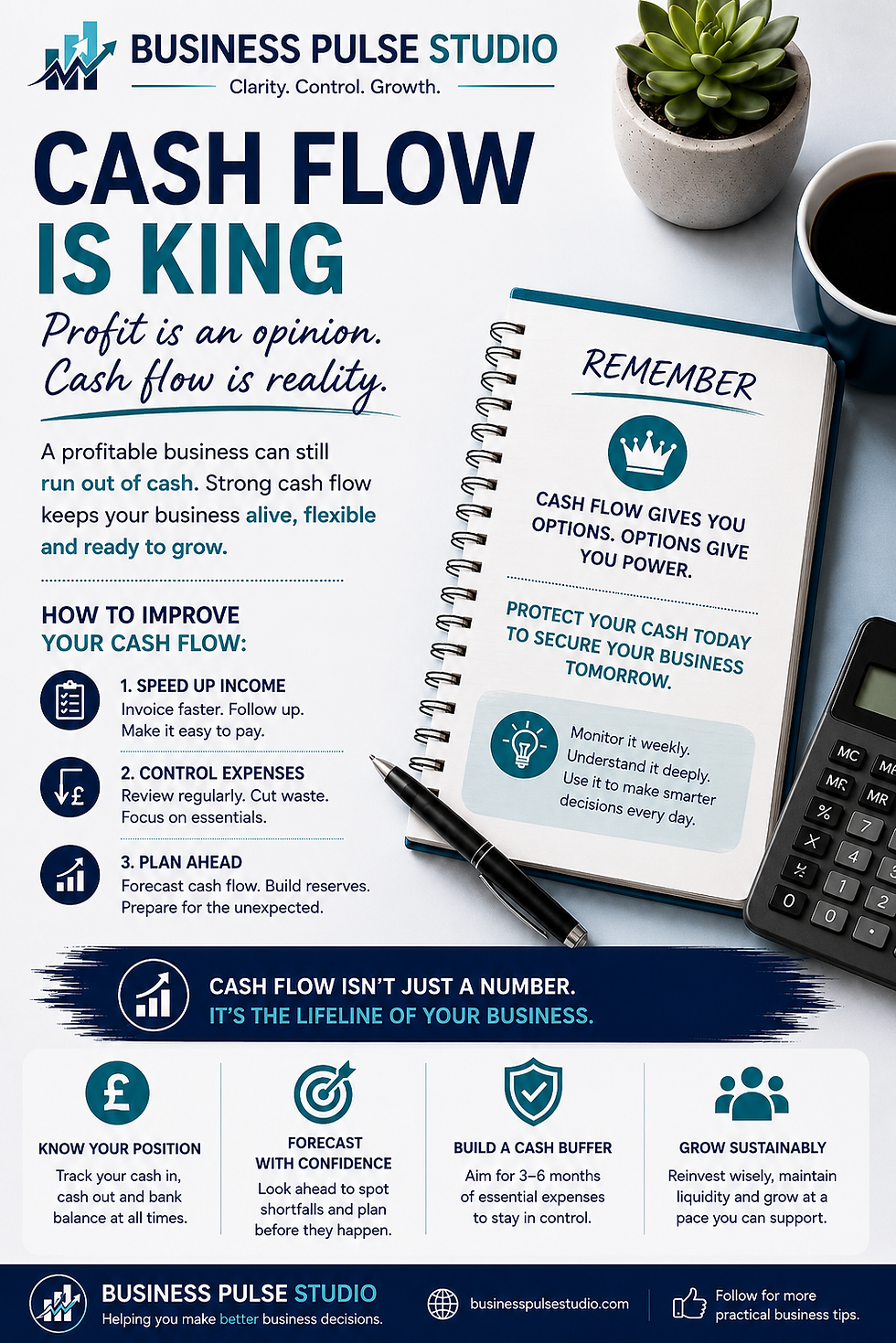
Improve cash flow
Reinvest in marketing
Build financial resilience during economic uncertainty
Businesses that monitor their margins regularly are typically in a much stronger position to make informed decisions than those focusing solely on turnover.
The Profit Margin Formula
Profit margin is calculated using the following formula:
Profit Margin (%) = (Selling Price − Total Cost) ÷ Selling Price × 100
Let's look at a practical example.
Selling Price: £150
Total Cost: £90
Profit: £60
Calculation:
(£150 − £90) ÷ £150 × 100 = 40%
Although the calculation itself is straightforward, determining your true total cost is often where businesses make costly mistakes.
What Should Be Included in Your Costs?
Accurate pricing depends on understanding all of the costs involved in producing or delivering your product or service.
Many businesses only include direct costs and overlook operating expenses, resulting in margins that appear healthier than they really are.
Typical costs include:
Direct Costs
Materials
Inventory or stock purchases
Manufacturing costs
Packaging
Delivery charges
Direct labour
Operating Expenses
Rent
Utilities
Software subscriptions
Insurance
Marketing
Professional services
Equipment
Office expenses
Including these costs provides a much more realistic picture of profitability.
Profit Margin vs Markup
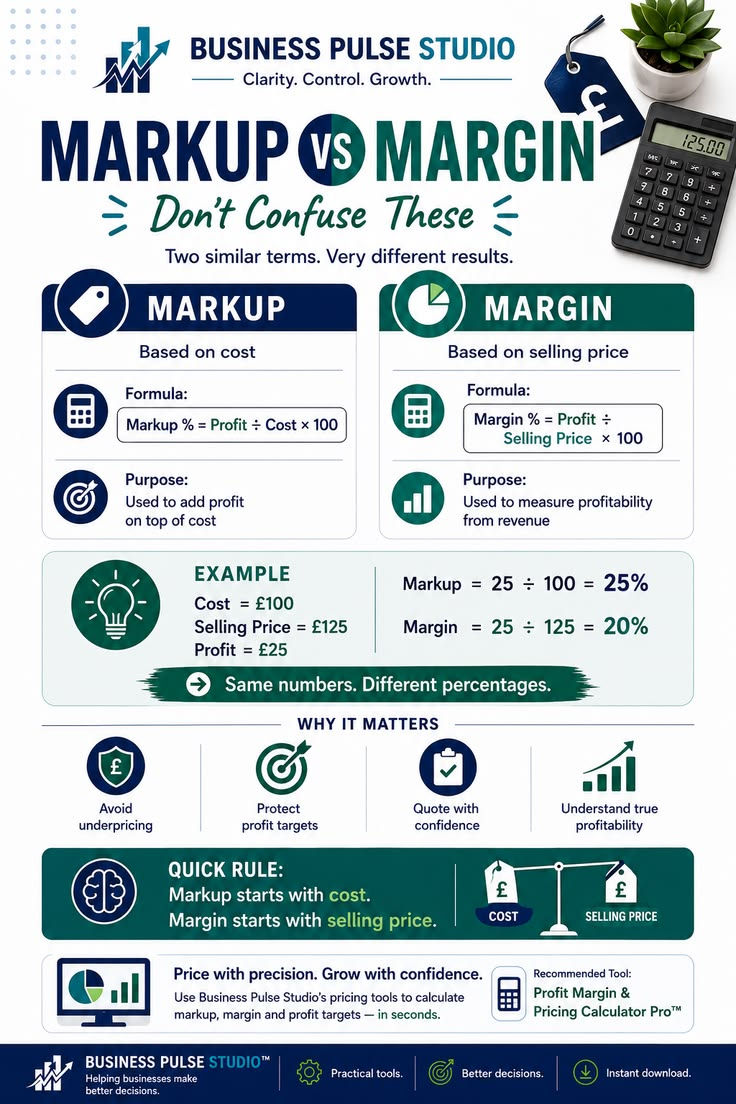
Profit margin and markup are frequently confused, yet they measure two different things.
Profit Margin measures profit as a percentage of the selling price.
Markup measures how much is added to the cost price to determine the selling price.
For example:
Cost | Selling Price | Profit | Markup | Margin |
£50 | £75 | £25 | 50% | 33.3% |
Understanding the difference helps prevent pricing errors and ensures products remain profitable.
Common Pricing Mistakes
Many businesses lose profit without realising it.
Some of the most common mistakes include:
Setting prices based solely on competitors.
Forgetting to include overhead costs.
Offering excessive discounts.
Failing to review prices regularly.
Underestimating labour costs.
Ignoring inflation.
Assuming higher sales always mean higher profits.
Even small pricing adjustments can significantly improve annual profitability.
Practical Ways to Improve Profit Margin
Improving profit margins doesn't always require substantial price increases.
Instead, consider the following strategies.
Review Costs Regularly
Regularly assess supplier pricing, subscriptions and operational expenses to identify opportunities for savings.
Increase Perceived Value
Customers are often willing to pay more for superior service, quality, reliability or convenience.
Review Prices Frequently
Costs change over time. Reviewing your pricing at least annually helps ensure your margins remain protected.
Understand Customer Profitability
Not every customer contributes equally to your business.
Identifying your most profitable customers enables you to focus your time and resources where they generate the greatest return. For businesses looking to streamline pricing and profitability analysis, the Business Pulse Studio™ Customer Profitability Dashboard Pro™
Why Many Businesses Use Pricing Tools
While calculating a single margin is relatively straightforward, pricing quickly becomes more complex when you introduce:
Multiple products
Labour costs
VAT
Discount scenarios
Material price changes
Multiple profit targets
Using a dedicated pricing calculator helps reduce manual errors, save time and make pricing decisions with greater confidence.
Simplify Your Pricing Decisions
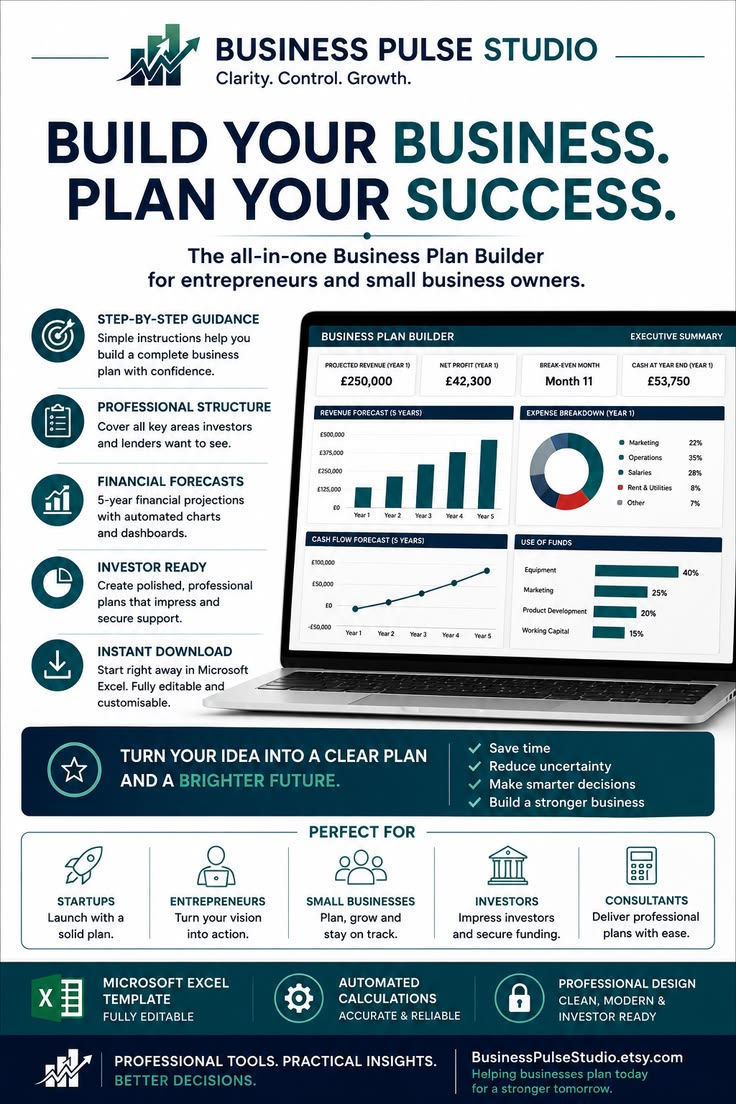
For businesses looking to streamline pricing and profitability analysis, the Business Pulse Studio™ Profit Margin & Pricing Calculator Pro™ has been designed to automate many of these calculations.
The workbook enables you to:
Calculate accurate selling prices
Compare markup and margin
Analyse the impact of discounts
Forecast profitability
Make more informed pricing decisions
Rather than relying on manual calculations, it provides a structured framework for understanding how pricing decisions affect your bottom line.
Final Thoughts
Profit margin is one of the most valuable financial metrics any business can monitor.
Businesses that understand their numbers are better equipped to make confident pricing decisions, improve profitability and build sustainable growth.
By reviewing your margins regularly, understanding your true costs and using reliable financial tools, you place your business in a much stronger position to succeed over the long term.
Whether you're pricing your first product or managing an established business, understanding profit margin is a skill that will continue to deliver value throughout your business journey.
Frequently Asked Questions
What is a good profit margin?
There is no universal benchmark. Profit margins vary considerably between industries, business models and markets. The most important measure is maintaining margins that support sustainable growth and healthy cash flow.
Is profit margin the same as markup?
No. Profit margin is based on the selling price, while markup is based on the cost price. Although related, they produce different percentages and should not be used interchangeably.
How often should I review my prices?
You should review your pricing whenever costs change significantly and, as a minimum, at least once a year. Regular reviews help protect profitability as expenses and market conditions evolve.
Can I calculate profit margin in Microsoft Excel?
Yes. Microsoft Excel is an excellent platform for calculating margins, particularly when using structured templates that automate calculations and reduce the risk of manual errors.
Comments