
Markup vs Margin: What’s the Difference and Why Does It Matter?

Markup and margin are two of the most important numbers in business pricing and two of the easiest to confuse.
They both describe profit, they are both expressed as percentages, and they are often used when deciding how much to charge for a product or service.
But they are not the same thing.
Confusing markup with margin can lead to prices being set lower than intended, profit targets being missed, and a business appearing more profitable on paper than it really is.
For small business owners, freelancers, online sellers and service providers, understanding the difference between markup and margin is therefore essential.
In this guide, we'll explain exactly what markup and margin mean, show you how to calculate each one, demonstrate why the percentages are different, and explain how to use them when making pricing decisions.
What Is Markup?
Markup measures how much you add to the cost of a product or service to arrive at your selling price.
It is calculated as a percentage of cost.
For example, imagine a product costs your business £100 and you sell it for £150.
Your profit is:
£150 selling price − £100 cost = £50 profit
Your markup is then calculated as:
Markup % = Profit ÷ Cost × 100
So:
£50 ÷ £100 × 100 = 50% markup
You have added 50% of the original cost onto the cost price.
That gives you a selling price of £150.
Markup is particularly useful when setting prices because it provides a quick way to work upwards from your costs.
What Is Profit Margin?
Profit margin looks at the same £50 profit from a different perspective.
Instead of measuring profit against the cost of the product, margin measures profit as a percentage of the selling price.
The formula is:
Margin % = Profit ÷ Selling Price × 100
Using our same example:
Selling price = £150Cost = £100Profit = £50
Therefore:
£50 ÷ £150 × 100 = 33.3% margin
So a product with a 50% markup only produces a 33.3% profit margin.
This difference is where many pricing mistakes begin.
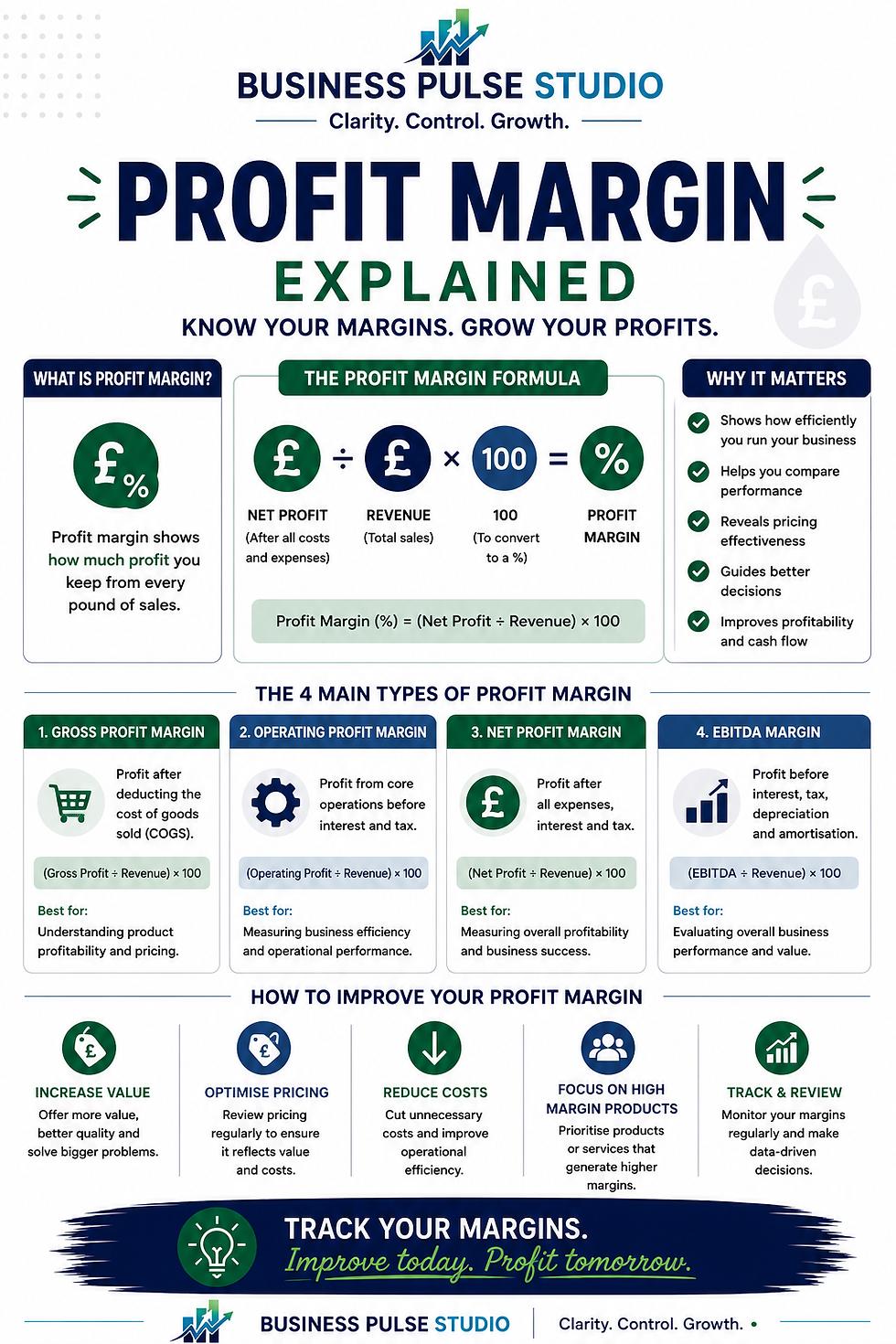
If you would like a deeper explanation of margins and how they affect profitability, see our complete guide to calculating profit margin.
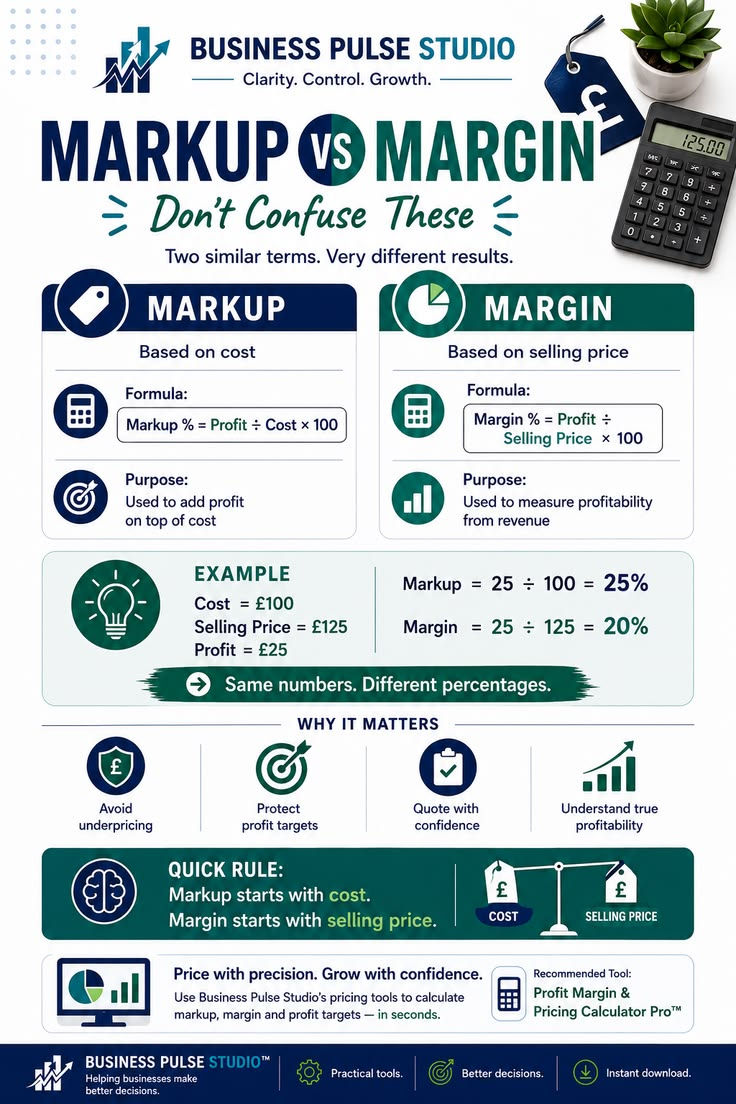
Markup vs Margin: What's the Difference?
The key difference is the number each calculation is measured against.
Markup is calculated against cost.
Margin is calculated against selling price.
Consider a product costing £100.
Cost | Selling Price | Profit | Markup | Margin |
£100 | £120 | £20 | 20% | 16.7% |
£100 | £125 | £25 | 25% | 20% |
£100 | £150 | £50 | 50% | 33.3% |
£100 | £175 | £75 | 75% | 42.9% |
£100 | £200 | £100 | 100% | 50% |
This table demonstrates an important principle:
A 50% markup does not mean a 50% margin.
In fact, to achieve a 50% profit margin on a £100 cost, you would need to sell the item for £200 — equivalent to a 100% markup.
Why Confusing Markup and Margin Can Be Expensive
Suppose you want to achieve a 40% profit margin. Your product costs £60. You might assume that adding 40% to the cost will achieve your target.
A 40% markup would give you:
£60 × 1.40 = £84 selling price
Your profit would therefore be £24.
However, your actual margin is:
£24 ÷ £84 × 100 = 28.6%
You wanted a 40% margin.
You achieved only 28.6%.
To achieve a true 40% margin, the calculation is different:
Selling Price = Cost ÷ (1 − Desired Margin)
Therefore:
£60 ÷ (1 − 0.40)
£60 ÷ 0.60 = £100
To achieve a 40% margin on an item costing £60, you would need to charge £100.
That's a £16 difference in selling price caused purely by confusing markup with margin.
Across hundreds or thousands of sales, that difference can become significant.
Markup Formula
The standard markup formula is:
Markup % = (Selling Price − Cost) ÷ Cost × 100
Or, if you already know your profit:
Markup % = Profit ÷ Cost × 100
Example
Cost: £80Selling price: £120Profit: £40
£40 ÷ £80 × 100 = 50% markup
Profit Margin Formula
The standard margin formula is:
Margin % = (Selling Price − Cost) ÷ Selling Price × 100
Or:
Margin % = Profit ÷ Selling Price × 100
Example
Cost: £80Selling price: £120Profit: £40
£40 ÷ £120 × 100 = 33.3% margin
Same transaction.
Same £40 profit.
Different percentage.
That is why understanding which measurement you are using matters.
How to Convert Markup Into Margin
If you know your markup percentage, you can convert it into margin using:
Margin = Markup ÷ (1 + Markup)
For example, with a 50% markup:
0.50 ÷ 1.50 = 0.333
Therefore:
50% markup = 33.3% margin
Here are several useful conversions:
Markup | Equivalent Margin |
10% | 9.1% |
20% | 16.7% |
25% | 20.0% |
30% | 23.1% |
40% | 28.6% |
50% | 33.3% |
75% | 42.9% |
100% | 50.0% |
150% | 60.0% |
200% | 66.7% |
This is worth remembering if you regularly price products by adding a standard markup to cost.
How to Convert Margin Into Markup
You can also work backwards.
If you know the margin you want to achieve, use:
Markup = Margin ÷ (1 − Margin)
For example, if you want a 30% margin:
0.30 ÷ 0.70 = 0.4286
You therefore need approximately a:
42.9% markup
For a 40% margin:
0.40 ÷ 0.60 = 0.6667
You need approximately a:
66.7% markup
And for a 50% margin:
0.50 ÷ 0.50 = 1.00
You need a:
100% markup
This is one of the reasons businesses should avoid choosing an arbitrary markup without first understanding the margin it actually produces.

Should You Use Markup or Margin When Pricing?
Both are useful, but they answer different questions.
Markup is useful when asking:
“How much should I add to my costs?”
Margin is useful when asking:
“How much of each pound of sales am I actually keeping as gross profit?”
For day-to-day pricing, markup can provide a quick starting point.
For profitability analysis, financial planning and performance management, margin often provides the clearer picture because it shows the proportion of sales revenue remaining after the relevant costs have been deducted.
A sensible pricing process should therefore consider both.
Start with your costs.
Determine the margin you need.
Calculate the selling price required to achieve it.
Then check whether that price is commercially realistic for your market and customer.
Don't Forget Your True Costs
Correctly calculating markup and margin only helps if the cost figure you start with is accurate.
For a physical product, the true cost may include more than the purchase price of the item.
Depending on your business, costs might include:
Materials
Packaging
Shipping or delivery
Transaction fees
Marketplace fees
Direct labour
Manufacturing costs
Subcontractor costs
Payment processing fees
Returns or wastage
For a service business, you may need to consider employee or contractor time, travel, software, equipment and other direct costs associated with delivering the work.
If these costs are omitted, your calculated margin may look healthy while your actual profitability is considerably weaker.
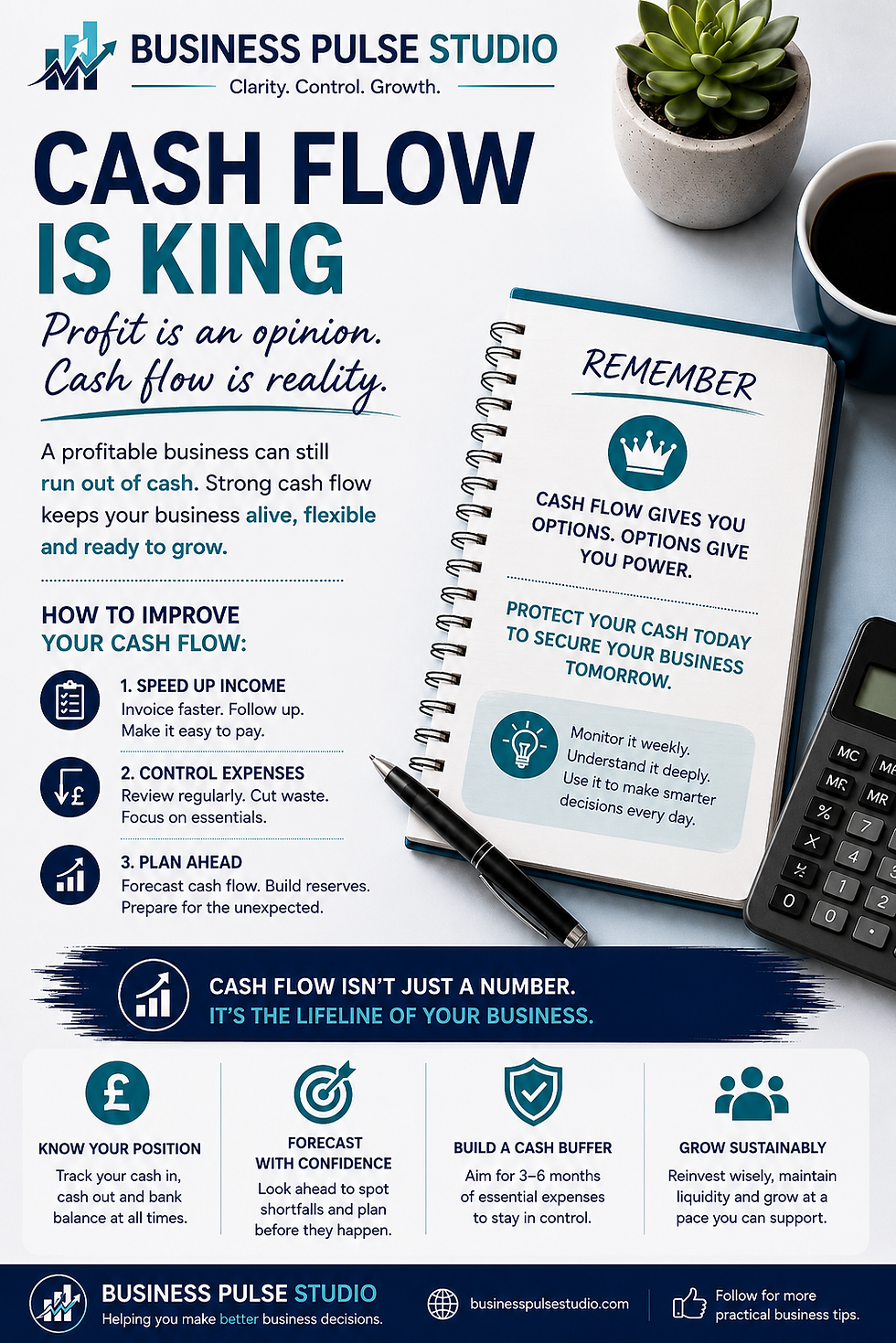
This is also why understanding your cash flow matters alongside profitability. A profitable sale does not necessarily mean cash will be available at the point your business needs it.
What Happens When You Discount Your Price?
Discounting is another area where understanding margin becomes particularly important.
Imagine:
Cost = £60Normal selling price = £100Profit = £40Margin = 40%
You then offer a 20% discount.
Your new selling price becomes:
£100 × 80% = £80
Assuming the cost remains £60, your profit falls to:
£80 − £60 = £20
Your margin is now:
£20 ÷ £80 = 25%
The selling price fell by 20%.
But profit per sale fell by 50%.
This illustrates why discounts should be evaluated based on their impact on profit — not simply on the percentage being offered to the customer.
A discount can still be commercially worthwhile if it produces additional volume, attracts new customers or moves stock, but the numbers should be understood before the decision is made.
Why Higher Revenue Doesn't Always Mean Higher Profit
Revenue is important, but sales growth on its own does not guarantee stronger profitability.
A business can increase sales while simultaneously reducing the amount of profit made on each transaction.
For example, aggressive discounting might increase the number of orders while reducing the margin earned on each one.
Similarly, rising supplier costs that are not reflected in selling prices can gradually compress margins even while revenue remains stable.
This is why business owners should monitor pricing and margins alongside revenue.
The objective isn't simply to sell more.
It is to understand what you earn from what you sell.
A Simple Pricing Example
Imagine you sell a product with the following costs:
Product cost: £35 Packaging: £3 Transaction and marketplace fees: £5 Direct fulfilment cost: £2
Your total cost is therefore:
£45
You want a 40% gross margin.
Rather than adding 40% to £45, calculate the selling price required to produce a genuine 40% margin:
Selling Price = £45 ÷ (1 − 0.40)
Selling Price = £75
At £75:
Revenue = £75Cost = £45Profit = £30
£30 ÷ £75 = 40% margin
Your markup is:
£30 ÷ £45 = 66.7% markup
This demonstrates why starting with your desired margin can often produce a much more accurate pricing decision than simply choosing a markup percentage.
How Often Should You Review Your Margins?
Pricing should not necessarily be treated as a one-time decision.
If your costs change but your selling price does not, your margin changes automatically.
Supplier increases, wage costs, packaging, delivery charges, marketplace fees and other expenses can gradually reduce profitability without any obvious change in headline sales.
Margin reviews can therefore be useful when:
Supplier prices change
Labour costs increase
You introduce discounts
New fees are introduced
You launch a new product or service
Sales increase but profit does not
Your operating model changes
Regularly checking the relationship between cost, price and profit helps make those changes visible.
Use the Numbers to Make Better Pricing Decisions
Markup and margin are simple calculations, but they can have a major influence on pricing decisions.
Remember:
Markup measures profit against cost.
Margin measures profit against selling price.
They are not interchangeable.
A 50% markup produces a 33.3% margin.
A 100% markup produces a 50% margin.
And if you want to achieve a specific margin, simply adding the same percentage to your cost will not produce it.
Understanding this relationship can help you set more accurate prices, assess discounts properly, monitor rising costs and protect profitability as your business grows.
If you regularly price products or services, our Profit Margin & Pricing Calculator Pro™ is designed to automate these calculations and help you understand the impact of costs, margins, markups, selling prices and discounts before making pricing decisions.
Better pricing starts with understanding the numbers.
Clarity. Control. Growth.

Frequently Asked Questions
Is markup the same as profit margin?
No. Markup measures profit as a percentage of cost, while profit margin measures profit as a percentage of selling price. Because they use different starting figures, the percentages are different.
Is a 50% markup the same as a 50% margin?
No. A 50% markup produces a margin of approximately 33.3%.
For example, a product costing £100 with a 50% markup would sell for £150. The £50 profit represents 33.3% of the £150 selling price.
What markup do I need for a 30% margin?
A 30% margin requires approximately a 42.9% markup.
What markup do I need for a 40% margin?
A 40% margin requires approximately a 66.7% markup.
What margin is a 100% markup?
A 100% markup produces a 50% margin.
For example, an item costing £50 and sold for £100 generates £50 profit. That £50 represents 50% of the £100 selling price.
Should I calculate markup or margin when setting prices?
Both can be useful. Markup helps calculate how much is being added to cost, while margin helps measure how much of the final selling price remains as profit. If you have a target margin, calculate the selling price required to achieve that margin rather than simply adding the same percentage to cost.
Comments